The Artica HTTP client periodically fetches update indexes, licenses, objects, and software packages.
It can also act as a watchdog, continuously checking the server’s Internet connectivity.
It defines the system-wide outgoing HTTP policy of the appliance: which upstream proxy to use — and, through Proxy exclusions, which internal hosts must be reached directly without any proxy.
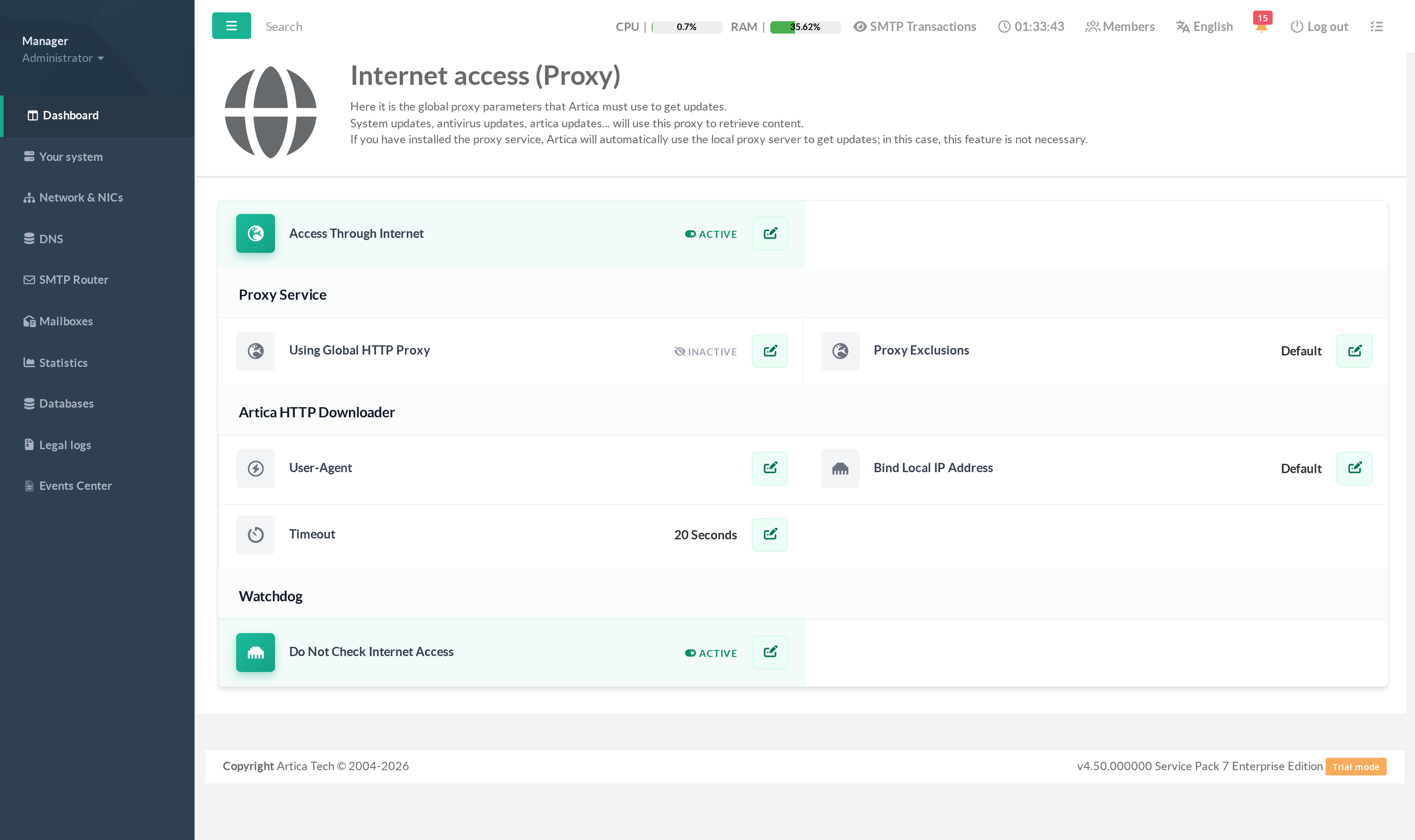
The Artica HTTP client parameters section is located using the left menu Your System > Update > Internet access
¶ General settings
- Access Through Internet:
This option indicates that the Artica server can connect to the Internet to check for updates.
If this option is unchecked, Artica will no longer try to test and retrieve Internet components.
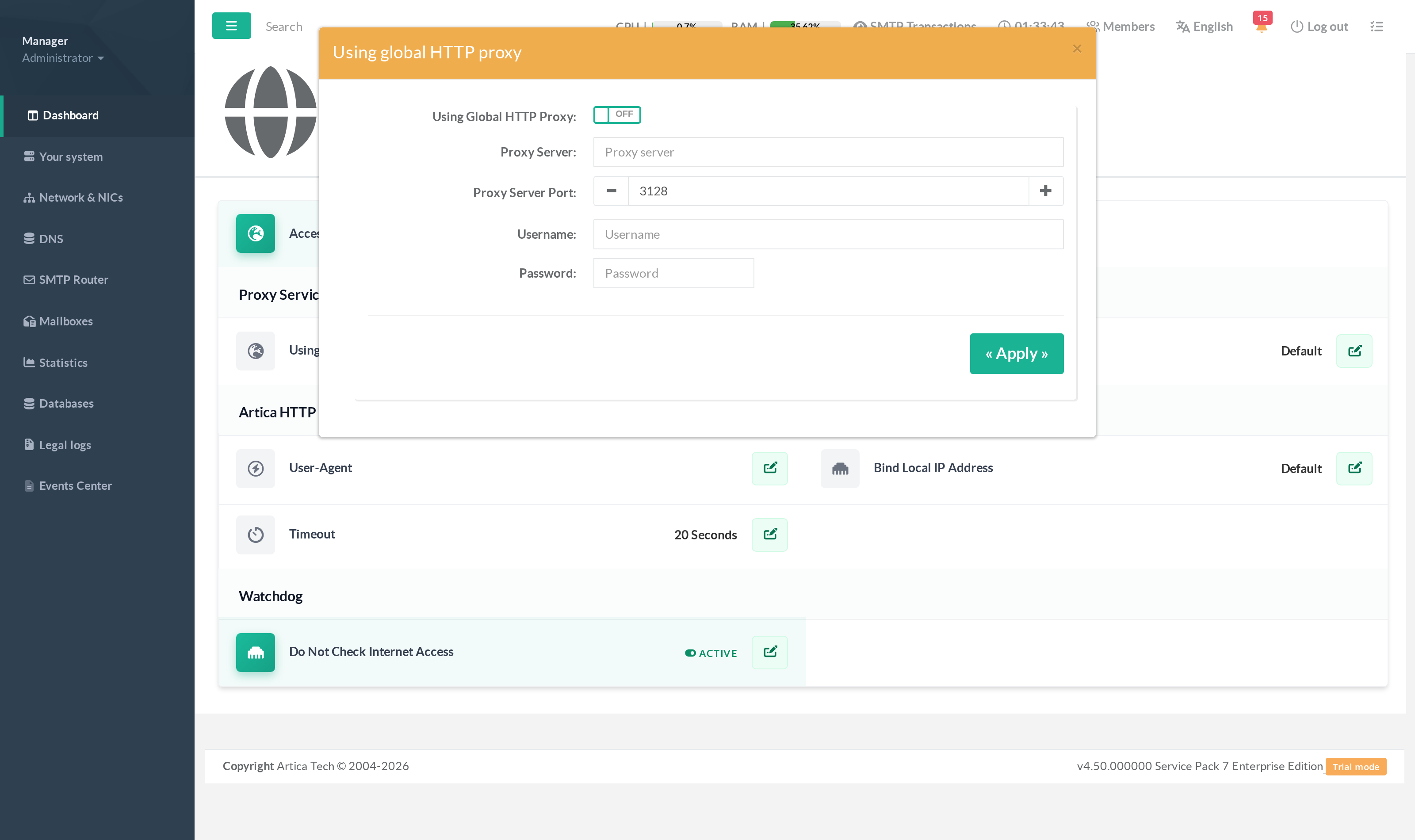
- Using Global HTTP Proxy:
If the client needs to use an upstream proxy to access the Internet, use this option to specify the connection parameters to the company’s proxy server (address, port and optional credentials).
When enabled, Artica also propagates the proxy to the whole system:/etc/environment,/etc/profile.d/proxy-mycompany.sh, the APT configuration and the environment of the services it manages.
- Use Local Proxy (Enabled by default)
If the Proxy service is installed locally on the machine, the client will use the proxy service to connect to the Internet.
In fact, you can tell the proxy service, for example, to use a specific routing (father proxy or network card) to connect to the Internet.
The Artica HTTP client will then have the right routing to access the Internet.
If, on the other hand, the local proxy fails, disable this option so that the Artica client will work in stand-alone mode.
¶ Proxy exclusions (NO_PROXY)
Available on up-to-date Artica releases. Requires both an updated Web console and an updated Artica engine.
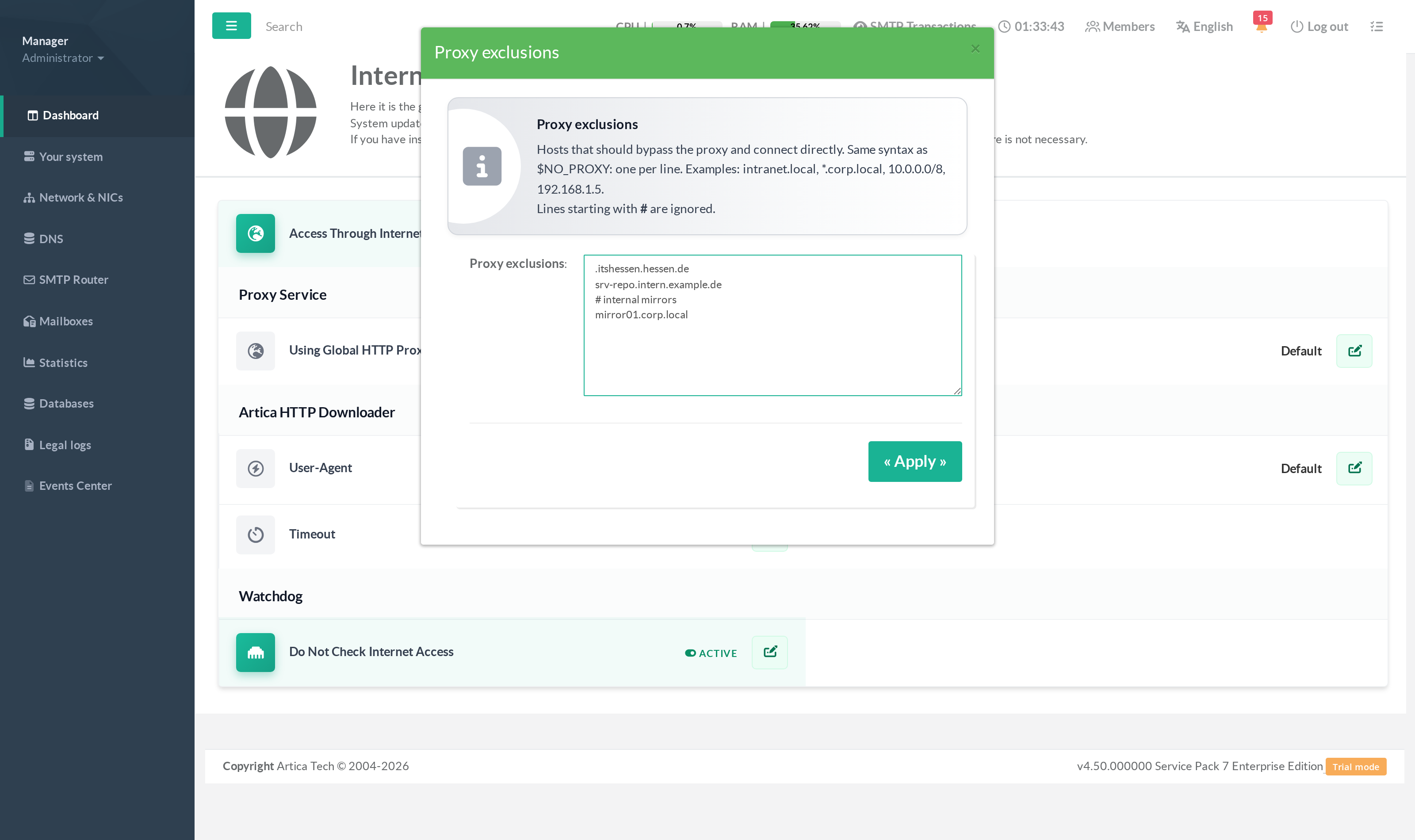
When a global HTTP proxy is configured, every outgoing HTTP request made by the system follows it — including requests to internal servers (software mirrors, PKI/CRL distribution points, internal repositories…) that the upstream proxy may refuse or cannot reach. The Proxy exclusions entry manages the system-wide NO_PROXY list: hosts and domains listed there bypass the proxy and are contacted directly.
Artica always provisions a safe base list — 127.0.0.1, localhost, 192.168.0.0/16, 10.0.0.0/8, 172.16.0.0/12 — and your exclusions are appended to it.
¶ A CIDR network never excludes a domain name
This is the trap that motivates this feature. Tools such as curl or wget match the NO_PROXY list against the hostname written in the URL, not against the IP address it resolves to. A CIDR entry (for example 10.0.0.0/8) only matches when the URL itself contains a literal IP address:
curl https://10.7.24.52/→ matched by10.0.0.0/8, the proxy is bypassed.curl https://server01.intern.example.de/→ NOT matched by10.0.0.0/8, even if that name resolves to 10.7.24.52 — the request still goes through the proxy.
To reach internal servers by name without the proxy, add the domain suffix itself, e.g. .intern.example.de.
¶ Syntax
One entry per line (commas, semicolons or spaces are accepted as well). Lines starting with # are treated as comments and ignored.
.intern.example.de— a leading dot excludes the whole domain and every host under it.mirror01.corp.local— a single host.192.168.1.5— a single IP (matches URLs using that literal IP).10.0.0.0/8— a network range (matches URLs using a literal IP inside the range).
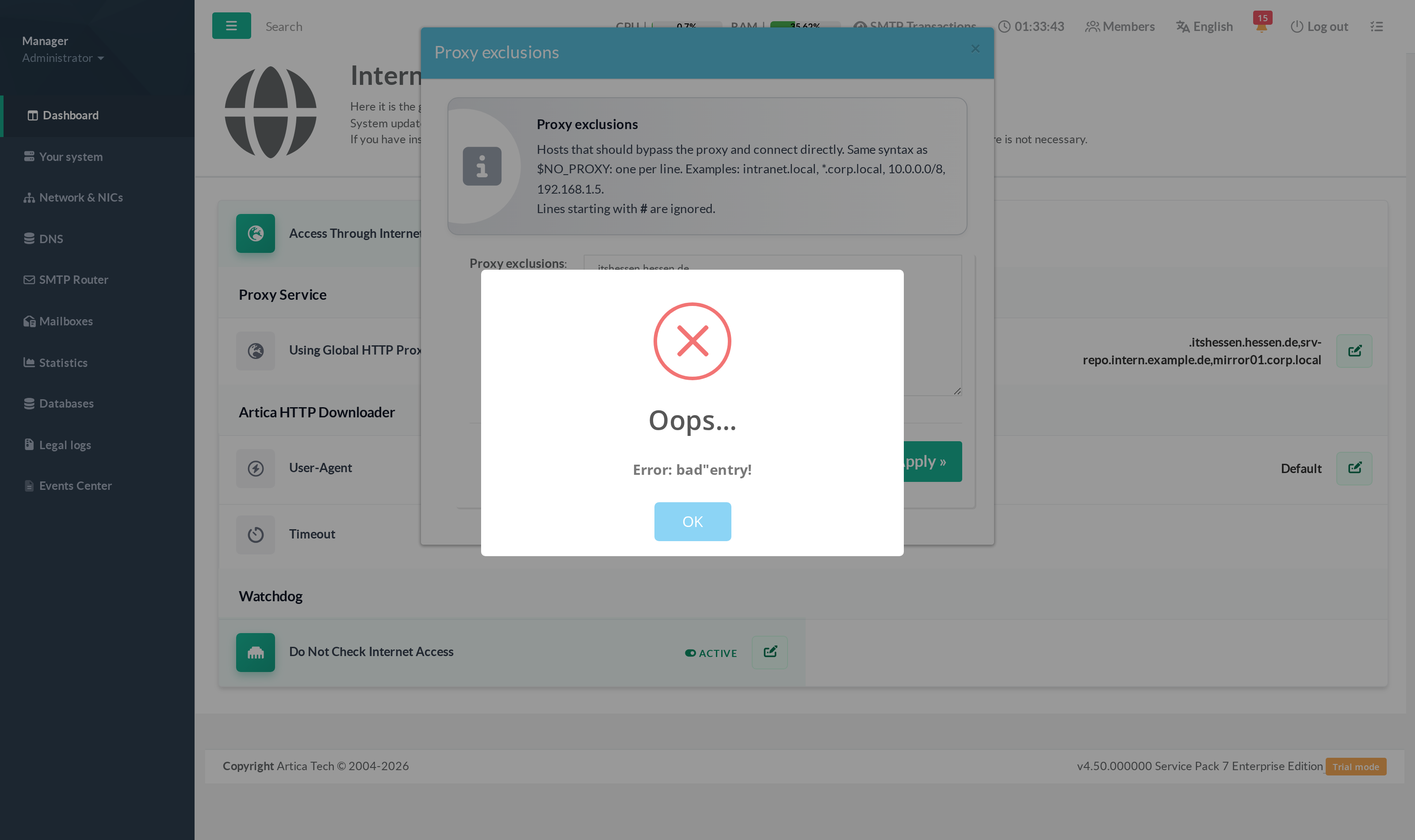
Entries are validated when you click Apply: only the characters A-Z a-z 0-9 . : / * _ - are allowed. If a line contains anything else (spaces inside an entry, quotes…), the save is refused and the offending entry is displayed — nothing is stored until the list is clean.
¶ Where the exclusions are applied
After clicking Apply, Artica immediately regenerates the system-wide proxy environment with the merged list:
/etc/profile.d/proxy-mycompany.sh— login shells and scripts;/etc/environment— PAM-based sessions;- the environment of the Artica engine and of the services it supervises (systemd units pick the new value up when their unit file is next regenerated).
Example of the generated value:
NO_PROXY="127.0.0.1,localhost,192.168.0.0/16,10.0.0.0/8,172.16.0.0/12,.articatech.net,srv-repo.intern.example.de,mirror01.corp.local"
The list is stored in the Artica configuration backend and survives reboots and reconfigurations — unlike a manual export NO_PROXY=…, which Artica overwrites the next time it rebuilds the proxy environment. Already-running shells keep their old environment: log out/log in (or open a new SSH session) to see the new value.
The saved list is displayed next to the Proxy Exclusions entry; the value Default means that only the base list is active.
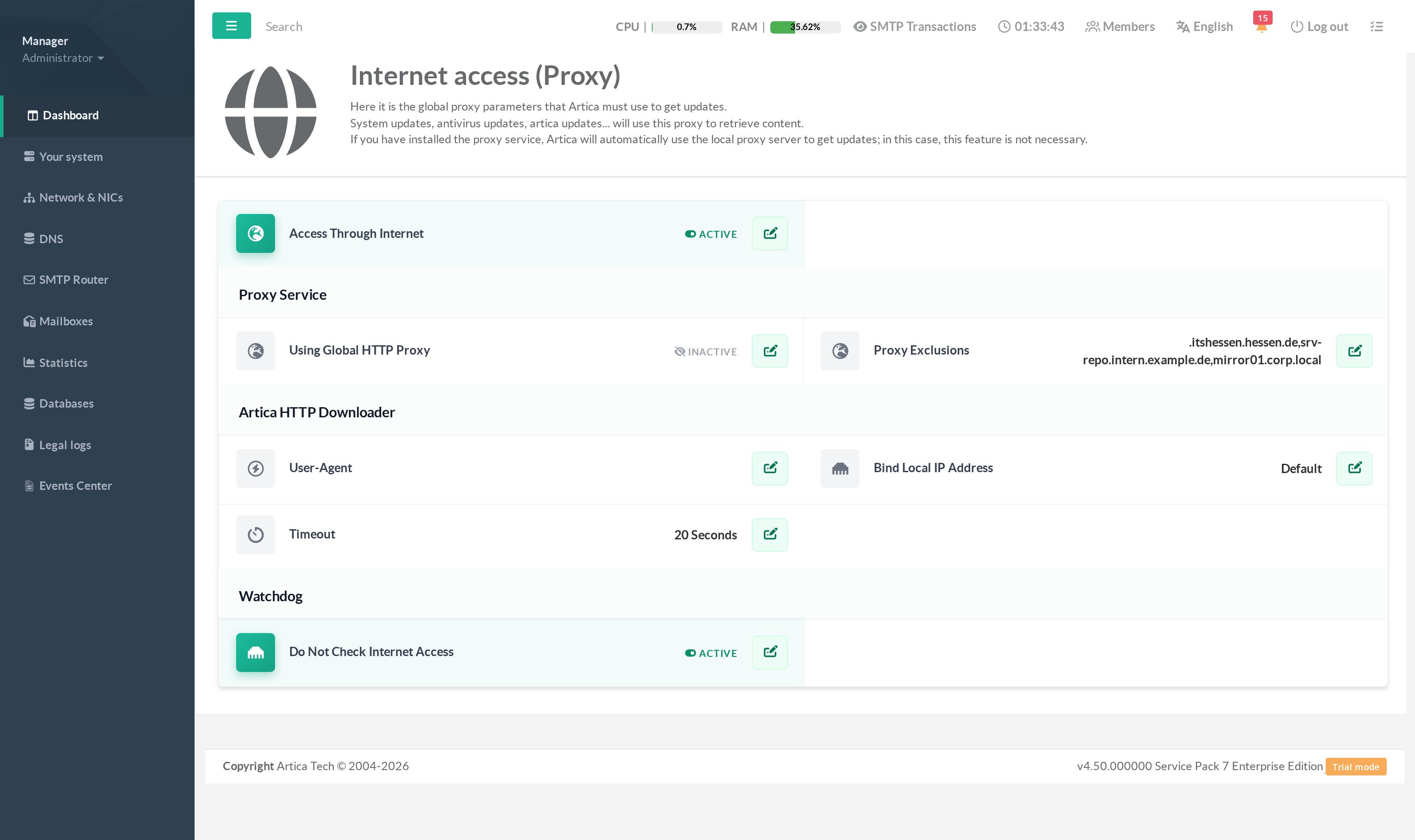
¶ Artica HTTP Downloader
- User-Agent:
Modifies the HTTP header User-Agent string sent by the Artica downloader.
- Bind Local IP Address:
Tells the HTTP client to use a specific network card to access the Internet.
By default, the client uses the network card with the default gateway.
- Timeout:
This is the maximum time for downloading and accessing Internet objects.
¶ Watchdog
- Do Not Check Internet Access:
Instructs the client not to test the Internet connection regularly. When the watchdog is active, Artica continuously verifies Internet connectivity and informs the administrator in the event of any interruption or malfunction of Internet access.