Data lifetime in databases
Public IP addresses have a certain rotation. Particularly addresses from a pool of ISPs. It is therefore necessary to refresh the database.
Public IP addresses have a certain rotation. Particularly addresses from a pool of ISPs.
It is therefore necessary to refresh the database.For example, if a hacker hosted by a provider has an IP address temporarily assigned to him, it may be that 3 days later, this address is assigned to a legitimate person.
You can choose between two lifetime systems:
lifetime of the database
All records stored in the database will be deleted if they exceed a specified lifetime in days.
This lifetime is indicated in the database parameters (default: 30 days).
The Record Lifetime ( Days ) let you define this property.
The value
0indicates that the data is stored permanently (which is a feature of the default blacklist database).
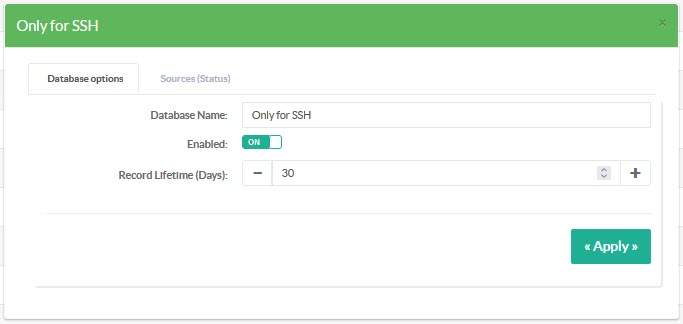
Artica cleans every 24 hours, so the minimum value is 1 day.
lifetime of an external source
All records from an external source can be eliminated periodically
In this case, the value
0means that records linked to this source must be destroyed each time an update is made.
The record lifetime can be defined in hours, unlike the lifetime of a database.
The default setting is 2160 hours or 3 months.
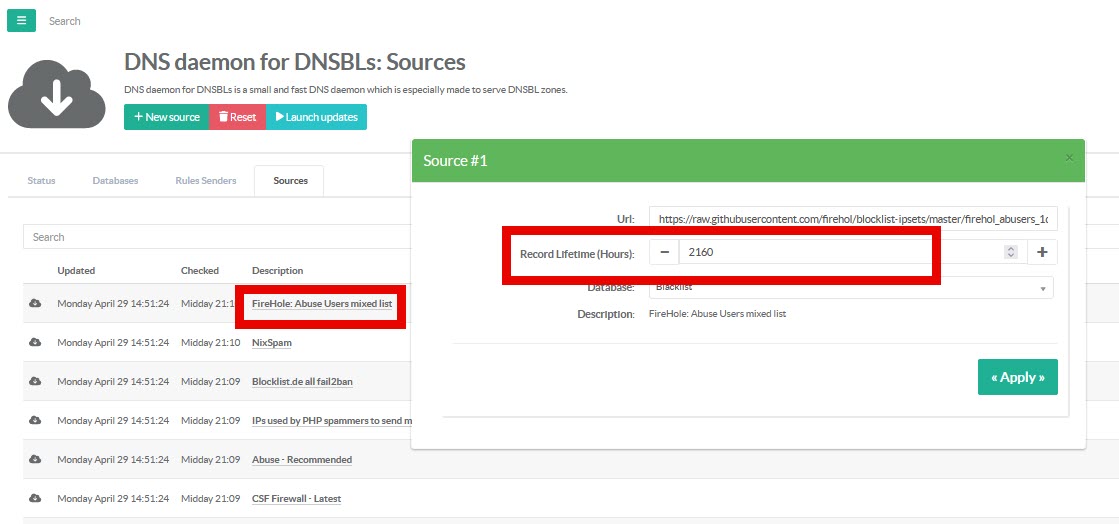
Cleaning is performed before each source update attempt, i.e. at least every two hours.